 Crawvix Editorial Team
· Published October 28, 2026 · Last updated October 27, 2026 · 2 min read
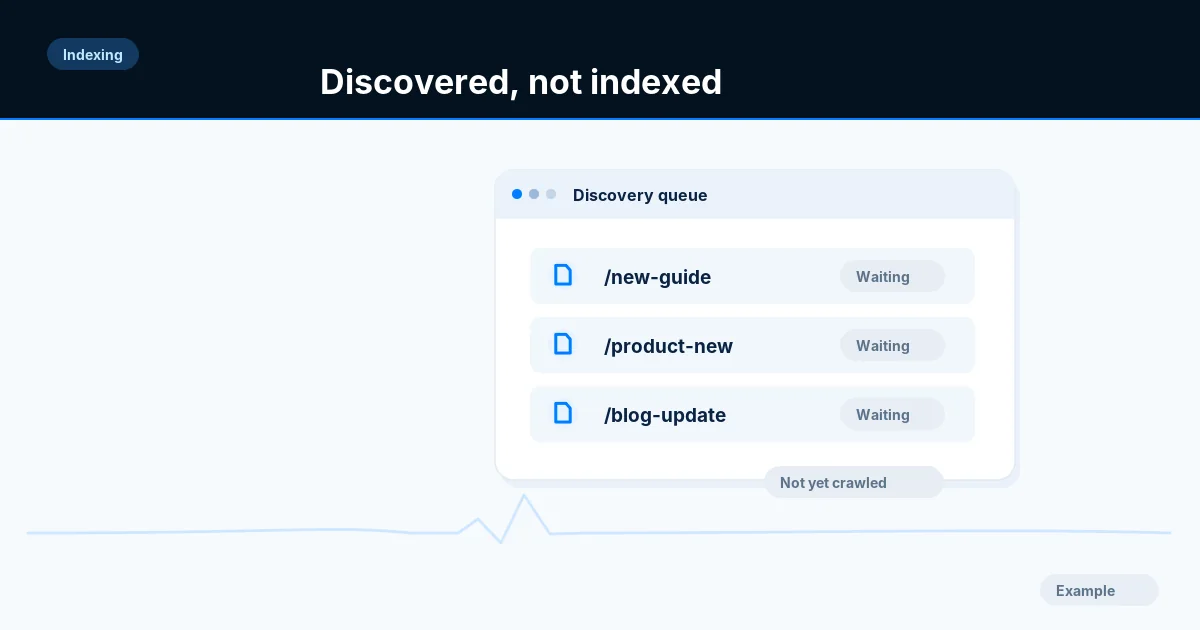
Google knows the URL exists but has not necessarily crawled it. For a large or newly launched website, distinguish crawl scheduling from broken discoverability or an unstable origin.
Before you begin
You will need access to the website or account involved, a list of important public URLs, and permission to make the relevant changes. Save a backup of configuration before editing DNS, server rules, source code or search settings. A successful check means the specified condition was verified—not that Google or Bing will index or rank the page.
Step-by-step instructions
Step 1: Identify important affected pages
Export examples and note discovery dates, content types and internal-link depth. Focus on key pages rather than counting every filter URL as a failure.
What success looks like: You can point to a small, prioritized set of URLs.
Step 2: Check server reliability
Examine recent 5xx and timeouts, response latency and CDN access policy. See whether other URLs from the same template are being successfully fetched.
What success looks like: There is no active origin or bot-access issue preventing crawls.
Step 3: Inspect crawl paths
Review internal links, XML sitemap membership and URL parameters. Remove useless crawl traps and give important pages straightforward HTML links from relevant sections.
What success looks like: Important URLs have direct discoverable paths.
Step 4: Validate content inventory
Eliminate accidentally created duplicate URLs, empty variants, transient facets and archived content that does not need search visibility.
What success looks like: The URL inventory reflects meaningful indexable content.
Step 5: Wait and verify with data
Watch crawl statistics, URL inspection and server logs over time. Search engines control crawl scheduling; fresh sites may take time.
What success looks like: The next review is tied to a real change or observation, not daily re-submission.
Final verification checklist
You can point to a small, prioritized set of URLs.
There is no active origin or bot-access issue preventing crawls.
Important URLs have direct discoverable paths.
The URL inventory reflects meaningful indexable content.
The next review is tied to a real change or observation, not daily re-submission.
Common mistakes to avoid
Assuming every discovered URL should be crawled immediately.
Fixing a crawl-budget theory before checking 5xx errors.
Publishing endless parameter permutations in the sitemap.
Frequently asked questions
What is the difference from Crawled — currently not indexed?
Discovered means the URL is known; crawled means Google fetched it before deciding not to index it.
Can I pay for instant Google indexing?
No legitimate tool can guarantee that ordinary URLs will be indexed on demand.
Related guides
Official references
https://developers.google.com/search/docs/crawling-indexing/troubleshoot-crawling-errors
https://developers.google.com/search/docs/monitor-debug/search-console-start
Next step: See how Crawvix checks a website and capture a baseline once scanning opens. This guide provides technical information, not a guarantee of rankings, 100-point Lighthouse scores or index inclusion.