 Crawvix Editorial Team
· Published October 28, 2026 · Last updated October 27, 2026 · 3 min read
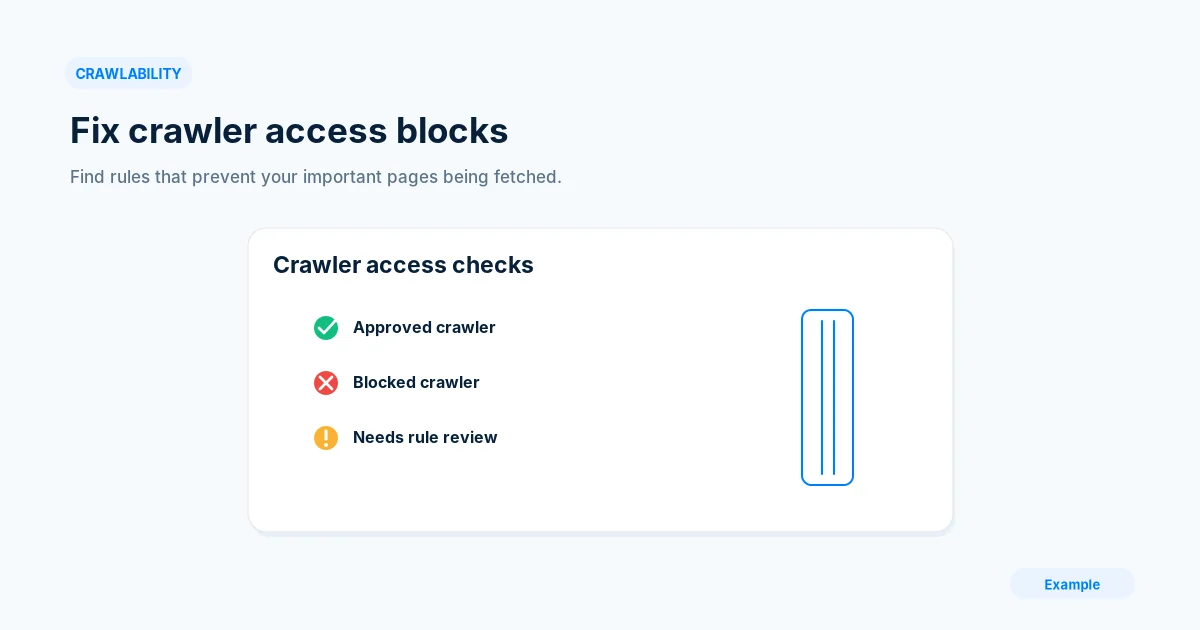
A CDN security rule may challenge or block a genuine search crawler. We want to restore necessary access without allowing spoofed bots or removing protections across the entire site.
Before you begin
You will need access to the website or account involved, a list of important public URLs, and permission to make the relevant changes. Save a backup of configuration before editing DNS, server rules, source code or search settings. A successful check means the specified condition was verified—not that Google or Bing will index or rank the page.
Step-by-step instructions
Step 1: Collect failing evidence
Find an affected URL, timestamp and response from crawler reports or logs. Determine whether the origin served the failure or Cloudflare generated it.
What success looks like: You know where the request was blocked.
Step 2: Review Cloudflare events
Inspect Security Events and matching bot, WAF and rate-limit rules at the relevant time. Note action, rule identifier, IP, user agent and request path; handle access logs as sensitive.
What success looks like: A specific security rule is implicated or excluded.
Step 3: Verify crawler identity
Do not trust a user-agent string alone. Use the search engine’s documented crawler verification mechanisms, such as published ranges or reverse/forward DNS checks where applicable.
What success looks like: Any exception is based on verified identity or a narrow trusted condition.
Step 4: Create the smallest exception
Adjust only the rule or paths causing trouble, preserving protection for malicious traffic. Prefer managed verified-bot signals where suitable rather than broad allow-all conditions.
What success looks like: Verified crawlers can fetch public pages while other protection remains intact.
Step 5: Retest and monitor
Compare fresh crawler reports, edge logs and origin responses. Record the rule change and rollback plan; allow time for search engines to crawl again.
What success looks like: The previously blocked route is accessible without creating a new security gap.
Final verification checklist
You know where the request was blocked.
A specific security rule is implicated or excluded.
Any exception is based on verified identity or a narrow trusted condition.
Verified crawlers can fetch public pages while other protection remains intact.
The previously blocked route is accessible without creating a new security gap.
Common mistakes to avoid
Allowlisting every request claiming to be Googlebot.
Disabling all WAF protection for the domain.
Assuming the origin is broken when a CDN challenge intervenes.
Frequently asked questions
Does seeing Googlebot in a user agent prove it is Google?
No. User agents can be spoofed. Verify identity against official crawler documentation.
Can the fix immediately restore rankings?
No. Restored access helps crawling, but search engines need time and other quality signals still matter.
Related guides
Official references
Next step: See how Crawvix checks a website and capture a baseline once scanning opens. This guide provides technical information, not a guarantee of rankings, 100-point Lighthouse scores or index inclusion.